

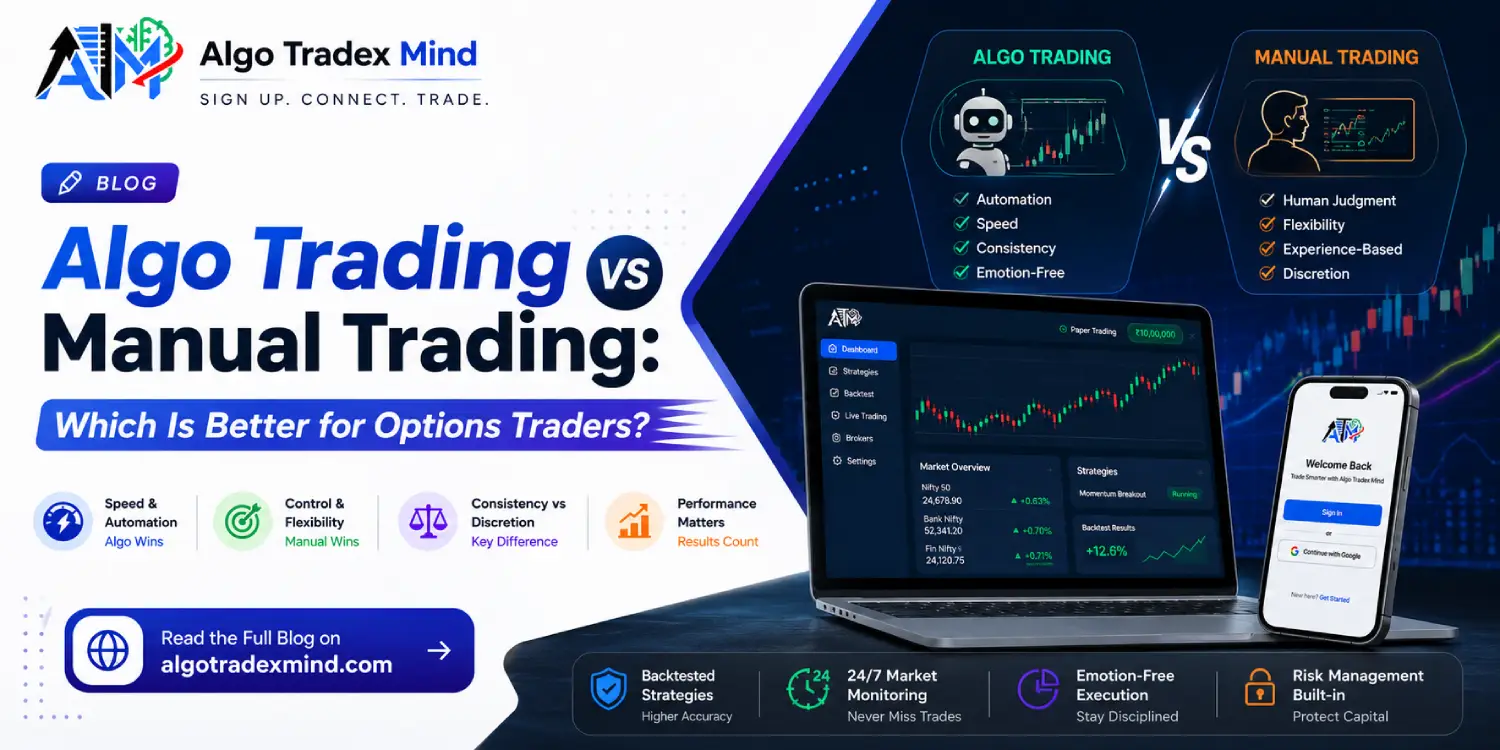
Options trading demands rapid execution and precise risk management. The debate regarding algo trading vs manual trading often confuses new participants. Automated systems execute pre-set rules instantly, eliminating hesitation. Manual execution allows for subjective observation but suffers from human delays. Understanding these approaches helps you choose the right path for your capital. This guide explains both methods, highlighting how modern technology shapes consistent options market performance.
What exactly is algo trading vs manual trading for options?
The comparison of these two approaches involves evaluating computational speed against human intuition. Algorithmic systems use computer code to place orders automatically based on predefined criteria like price or volume. Manual execution requires a person to analyse charts and click buttons to enter positions. Options traders prefer automation for speed, while traditional investors sometimes retain manual control for qualitative market news analysis.
Automation removes the mechanical burden from the trader. You set the rules once. The system monitors the market constantly. When conditions match your criteria, the software sends the order directly to the exchange. This process happens in milliseconds. Human operators simply cannot match this reaction time.
Options trading involves multiple variables changing simultaneously. The underlying asset price, implied volatility, and time decay constantly shift the value of your contracts. Tracking these changes manually across several strike prices causes cognitive fatigue. Software tracks these metrics effortlessly without losing focus.
You can construct complex multi-leg options strategies, such as iron condors or straddles, and trust the system to execute all legs simultaneously. Manual traders often experience leg risk. This occurs when you buy one option, but the price of the second option changes before you can click the buy button.
Institutional desks abandoned manual clicking decades ago. They realised that mathematical probability requires consistent execution. Retail participants now have access to similar technology. The transition requires a shift in mindset. You stop acting as the manual worker and become the manager of your automated systems.
How does emotion-free trading improve options profitability?
An emotion-free trading approach protects your capital from panic and greed. Automated systems follow programmed instructions without hesitation or fear of losses. Human traders frequently hold losing positions hoping the market reverses, or they sell winning positions prematurely to secure small profits. Algorithms execute stop-loss and take-profit orders exactly as defined, ensuring strict adherence to your original risk management plan.
Psychological interference destroys more trading accounts than poor market analysis. When real money is at risk, your brain releases adrenaline. This chemical reaction impairs logical decision making. You start seeing patterns that do not exist. You ignore obvious warning signs.
Software does not feel stress. If a trade reaches the daily loss limit, the system cuts the position immediately. Algo Tradex Mind includes a daily loss limit with a one-tap stop feature in our premium plans. This structural safeguard prevents catastrophic account drawdowns.
Consistent profitability requires executing the same edge repeatedly over hundreds of trades. You must accept a certain number of small losses to capture the larger statistical wins. Human operators struggle with losing streaks. After three consecutive losses, a manual participant might skip the fourth valid signal. If that fourth signal was the large winner, the trader ruins the mathematical expectancy of their strategy. By removing the human element, you ensure every valid setup gets traded.
| Feature | Automated Approach | Manual Approach |
|---|---|---|
| Rule Adherence | Strict and immediate | Flexible and inconsistent |
| Reaction to Loss | Cuts position at exact level | Frequently holds hoping for reversal |
| Trade Execution | Millisecond precision | Delayed by human processing time |
| Fatigue Factor | Operates continuously without rest | Decreases focus after a few hours |
What are the main manual trading mistakes that beginners make?
The most frequent manual trading mistakes involve poor position sizing and revenge trading. Beginners often allocate too much capital to a single options trade, risking account ruin. When a trade goes against them, they frequently double down to average their entry price. They also suffer from hesitation, entering trades late after the initial price movement has already occurred, severely reducing their profit margins.
Options contracts carry high leverage. A small movement in the underlying stock creates a massive percentage change in the option premium. Beginners underestimate this volatility. They buy out-of-the-money options expecting a lottery win, only to watch time decay erode their investment to zero.
Revenge trading happens after a painful loss. The operator feels angry at the market. They immediately enter a new, poorly planned position to win the money back. This behaviour abandons all logic. Automated software eliminates this risk entirely. The machine stops trading when it hits the predefined loss threshold.
Another common error involves over-complicating the technical analysis. Novices clutter their screens with dozens of indicators. This creates conflicting signals. The moving average says buy, but the oscillator says sell. The trader freezes. By the time they decide, the opportunity vanishes.
To avoid these pitfalls, participants should structure their rules logically. You can learn how it works to understand the step-by-step process of transitioning from disorganised manual clicks to systematic rule-based execution.
| Manual Mistake | Consequence | Automated Solution |
|---|---|---|
| Over-leveraging | Account liquidation | Fixed position sizing rules |
| Revenge Trading | Emotional capital drain | Hard daily loss limits |
| Hesitation | Missed entry prices | Instant API execution |
How do speed and discipline impact options order execution?
Maintaining speed and discipline guarantees that your strategy performs in live markets exactly as it did in historical tests. Options prices change rapidly during market opens and economic announcements. High-speed execution ensures you capture the intended price without severe slippage. Strict discipline ensures every setup is taken without human second-guessing, preserving the statistical edge of your system.
Slippage costs traders thousands of pounds annually. Slippage is the difference between the expected price of a trade and the actual price at which the trade executes. In manual environments, your reaction time plus your internet latency creates a delay. By the time your order reaches the exchange, the market makers have already adjusted the quotes.
Algorithmic execution connects directly to broker APIs. This bypasses the traditional user interface. The software calculates the signal and transmits the order instantly.
Discipline is the companion to speed. You might have the fastest internet connection available, but if you hesitate for ten seconds before clicking the mouse, the speed is useless. Automation enforces discipline by removing the human input requirement during the active session. You build the logic beforehand. You test it. You deploy it.
Institutional high-frequency firms spend millions to shave microseconds off their latency. Retail operators do not need microsecond speed, but they absolutely need millisecond reliability. Removing the human physical reaction time levels the playing field significantly against larger market participants.
What are the pros and cons of algorithmic execution in volatile markets?
The pros and cons of algorithmic systems become obvious during high volatility. The primary advantage is lightning-fast reaction to sudden price drops, securing profits before human operators even notice the move. The disadvantage is that algorithms cannot interpret unprecedented news events. A machine will continue buying a falling asset if the technical rules say so, unless proper volatility filters are programmed.
Volatility provides the movement necessary for options traders to generate returns. However, unpredictable swings also destroy unprotected capital.
Automated systems handle volatility by executing mathematical instructions without hesitation. If the market drops 5% in ten minutes, a human might freeze in panic. The algorithm simply reads the price feed, identifies that the stop-loss level has been breached, and liquidates the position to protect the remaining capital.
However, you must acknowledge the limitations. Algorithms lack common sense. If a major geopolitical event occurs, causing erratic and illogical market behaviour, the technical indicators will fail. A system will blindly buy a dip based on an oversold reading, oblivious to the external news causing the crash.
Professional operators solve this by adding volatility filters to their systems. They program rules that halt trading if the volatility index spikes above a certain threshold. They also use hard limits on maximum daily drawdowns. This ensures the system turns itself off if market conditions become too chaotic.
Can hybrid trading give you the best of both worlds?
Yes, hybrid trading combines human market intelligence with robotic execution speed. In this model, you perform the high-level market analysis and select the daily directional bias manually. You then program the software to find the exact entry and exit points. This keeps you in control of the overall strategy while delegating the repetitive, speed-dependent tasks to the computer.
Many professionals prefer the hybrid approach. They read the morning financial reports, review global liquidity trends, and determine that the market should trend upwards. They then configure their software to only take long positions for that specific session.
The human handles the context. The machine handles the mechanics.
This method is highly effective for options writing. If you identify a range-bound market, you can instruct the system to sell iron condors continuously until volatility expands beyond a set threshold. You do not need to sit and watch the screen for six hours. You simply monitor the general market environment periodically.
Algo Tradex Mind accommodates this workflow perfectly. Our platform allows rapid adjustments. You are never locked out of your own strategy. You can intervene manually, pause the system, or close all positions with a single click if your fundamental view of the market changes suddenly.
Does execution quality matter when deploying multiple strategies?
High execution quality determines whether a theoretical portfolio survives real-world market friction. When you run multiple strategies simultaneously, your account margin constantly fluctuates. Poor execution causes delayed orders, missed fills, and increased transaction costs. High-quality automated systems process queue limits efficiently, ensuring your portfolio of strategies operates smoothly without overlapping risk parameters or exhausting your available buying power prematurely.
Retail operators often start with a single strategy. Manual execution of one strategy is difficult but possible. Once you expand to three or four concurrent strategies, human execution becomes impossible.
Imagine tracking a trend-following system on the daily chart, a mean-reversion system on the 15-minute chart, and a volatility breakout system on the 5-minute chart. The cognitive load is immense.
Software handles parallel processing effortlessly. The Unlimited Plan allows you to test up to 10 strategies together as a portfolio. You can monitor the correlation between these systems. If all ten strategies decide to buy the same index simultaneously, a smart portfolio manager steps in.
Quality routing ensures the orders hit the exchange efficiently. We focus heavily on reducing API latency. When the signal triggers, the order is formulated and transmitted using optimised network pathways. This prevents the bottleneck effect that occurs when a standard retail computer tries to send twenty orders simultaneously.
How do you build options strategies without knowing how to code?
Modern platforms provide visual tools that eliminate the need for programming knowledge. You use drop-down menus and logical conditions to define your entry rules, target profits, and stop losses. By selecting technical indicators and specifying their values, you construct complex instructions mathematically. The platform translates your visual selections into computer code automatically, allowing anyone to build sophisticated trading models.
In the past, algorithmic execution was restricted to computer science graduates and institutional banks. You had to learn Python or C++ to interact with broker APIs. This barrier to entry kept retail participants at a massive disadvantage.
Today, visual builders democratise access to automation. You can define a condition simply. For example, you select the Relative Strength Index, set the parameter to cross above 30, and set the action to buy a call option.
You can combine multiple indicators. You can state that the moving average must point upwards, while the volume must be above average. The logic chains are infinite, yet they require zero syntax typing.
We designed our intuitive strategy builder to accommodate both beginners and advanced users. You do not need any coding experience. You simply point, click, and deploy. Furthermore, there is no KYC required for the software; just an email or mobile number is needed to sign up and start building.
Why is paper trading important before risking real capital?
Paper trading allows you to test your logic in live market conditions without financial risk. While historical backtesting shows past performance, simulated execution reveals how your strategy handles current spread sizes, execution delays, and real-time volatility. It highlights flaws in your risk management rules. Operating a simulated account builds your confidence in the automated system before you commit your hard-earned funds.
Also Read :
- What is Slippage Trading?
- How to Start Algo Trading in India?
- Option Trading Automatic Kaise Kare?
- How to Backtest Option Strategy?
Backtesting is the first step. You look at five years of data to see if your idea holds merit. However, backtesting has limitations. It assumes you get filled at the exact closing price of a candle. In reality, the bid-ask spread might be wide, causing immediate slippage.
Forward testing bridges this gap. You connect the software to a live data feed. The system generates signals and tracks theoretical profits and losses based on real-time market action.
Every operator should run a new strategy in a simulated environment for at least two weeks. If the system enters an infinite loop and buys 100 contracts by mistake, you want that to happen with fake money.
Algo Tradex Mind provides paper trading worth 10 Lakhs completely free of cost across all our plans. This ensures you can validate your ideas safely. You monitor the strategy during actual market hours, review the trade logs, and tweak the parameters before assigning real broker capital.
| Feature | Paper Trading | Live Execution |
|---|---|---|
| Capital Risk | Zero financial risk | Real capital at stake |
| Slippage Impact | Simulated based on feed | Real-world bid-ask spread |
| Emotional Stress | Minimal | High during volatility |
How do you choose the right broker for automated options trades?
Selecting a broker requires evaluating their API stability, margin requirements, and options commission structures. A broker might offer low fees, but if their API disconnects frequently, your automated strategy will fail to execute critical stop-loss orders. You need a broker that provides robust technical infrastructure, clear documentation, and rapid order processing to support high-frequency operations safely and consistently.
Not all brokerages support automated retail flow. Some actively discourage it by throttling API limits, meaning you can only send a few orders per second.
When evaluating a partner, look at their uptime history. During market crashes, retail brokers often experience server outages. Your software is useless if the broker's server rejects the connection.
Cost is another factor. Options trading involves per-contract fees. If your strategy trades 50 times a day, commissions will consume your profits rapidly. Negotiate rates or find a discount provider that caters to active participants.
Our platform integrates seamlessly with several top-tier providers. We maintain the API endpoints so you do not have to worry about the technical connections. You can review our integrated supported brokers list to find a platform that aligns with your specific margin requirements and regional availability.
| Evaluation Metric | Importance for Automation | Minimum Requirement |
|---|---|---|
| API Uptime | Prevents missed orders | 99.9% during market hours |
| Rate Limits | Allows portfolio scaling | Minimum 10 requests per second |
| Commission Rate | Protects profit margins | Flat fee per executed order |
| Margin Rules | Dictates strategy types | Supports complex options spreads |
What is the true cost of automated systems for retail traders?
The cost involves the software subscription, broker commissions, and potential data feed fees. Previously, building an automated setup cost thousands of pounds in developer fees and server hosting. Today, cloud-based software platforms offer complete infrastructure for a low monthly fee. This predictable pricing allows retail participants to access institutional-grade technology without heavy upfront capital expenditure or continuous maintenance costs.
To make automation accessible, Algo Tradex Mind is offering an inaugural 50% discount across our subscription packages for a limited time. You receive premium infrastructure at a fraction of the traditional cost.
Review our discounted pricing plans below:
Basic Plan - ₹1,299/ month (inaugural offer ₹650)
For traders ready to scale.
- 30 strategies and 60 backtests
- 3 live deployments
- Index options trading
- 10 Lakhs worth of paper trading to practice first
- Connect 1 broker
- Easy dashboard and email support
Limited Plan - ₹1,999/ month (inaugural offer ₹999)
For premium members requiring advanced tools.
- 60 strategies and 100 backtests
- 5 live deployments
- Index options trading
- Paper trading worth 10 Lakhs included
- Connect up to 3 brokers
- Test 3 strategies together as a portfolio
- Easy strategy building templates and simple performance reports
- Fast order execution and chat support
Unlimited Plan - ₹2,999/ month (inaugural offer ₹1,499)
Smart automation for rising traders.
- 150 strategies and 250 backtests
- 12 live deployments
- Index options trading
- Paper trading worth 10 Lakhs included
- Connect up to 5 brokers
- Test 10 strategies together as a portfolio
- Easy strategy building templates and detailed performance reports
- Fast order execution and daily loss limit with one-tap stop
- Trade journal/Newsletter access
- Early access to new features, priority support and a setup call
Frequently asked questions
Is coding required to start automated options trading?
No coding is required. Modern platforms use visual templates. You define your entry rules and profit targets using drop-down menus. The software automatically translates your selections into executable computer logic, allowing anyone to build complex models effortlessly.
Does algorithmic software guarantee financial profits?
No software guarantees profits. Algorithms strictly execute the mathematical rules you define. If your strategy possesses a statistical edge, the automation executes it flawlessly. If your underlying strategy is flawed, it will simply execute bad rules faster.
Can I pause the system during major news events?
Yes, pausing is highly recommended. You retain full control over your account. You can monitor the economic calendar and click a single button to pause live deployments before high-impact news releases, avoiding unpredictable market slippage.
Do I need special computer hardware for these systems?
No special hardware is needed. As a cloud-based software platform, all calculations and API transmissions happen on secure servers. You access your dashboard through a standard web browser on any basic laptop or desktop computer.
How long does it take to connect a broker account?
Connecting your account takes less than five minutes. You generate an API key from your brokerage portal and paste it into our dashboard. No complex paperwork or KYC is required for our software, ensuring rapid onboarding.
Taking the step towards automation shifts your focus from manual clicking to strategic system development. You stop reacting to the market and start managing a portfolio of mathematical rules.
Disclaimer: Algo Tradex Mind is a SaaS software platform. Trading involves risks, including the potential loss of capital. We provide the technological infrastructure for trade execution but do not offer financial advice or pre-built strategies. Past performance of any backtested system does not guarantee future results. Proceed carefully and test thoroughly.