

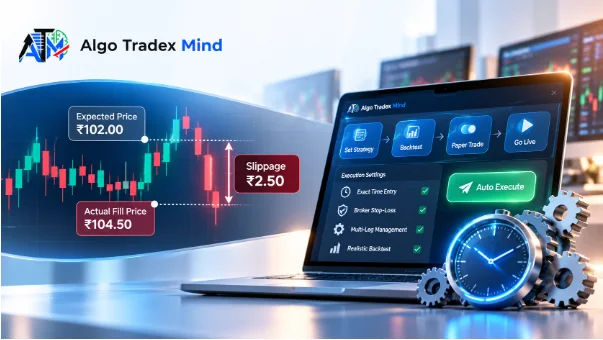
Traders often ask what is slippage in trading? after seeing a fill price that differs from the price on screen. Slippage is the gap between the price you expected and the price you actually received. In options algo trading, this gap repeats across every leg, entry and exit. Over a month, small differences of one or two rupees per unit can turn a profitable backtest into a disappointing live account.
What Is Slippage in Trading?
Slippage is the difference between the price your order was meant to fill at and the price it actually filled at. If your algo sends a buy order when a NIFTY call shows ₹120 and the fill comes at ₹121.50, you have ₹1.50 of slippage per unit. It happens because prices move quickly and the visible quote has only a limited quantity behind it.
Slippage Meaning With a Simple Example
The slippage meaning becomes clearer with a two-leg trade. Suppose your strategy sells a NIFTY 23300 CE and a 23300 PE at 09:20. The screen shows ₹110 and ₹100. Your fills arrive at ₹109.20 and ₹99.40. You collected ₹1.40 less premium per unit than planned, and nothing in your strategy logic was wrong. That is what makes it so frustrating.
Can Slippage Be Positive?
Yes. Positive slippage occurs when the fill is better than expected, such as buying at ₹119.50 when the trigger price was ₹120. It does happen from time to time, but negative slippage shows up more often in fast options markets, because your algo usually reacts to a move that is already under way.
What Causes Slippage in Algo Trading?
Slippage in algo trading comes from four main sources: price movement between signal and fill, the spread between buyers and sellers, order size larger than the quantity available at the best price, and delay in sending or processing the order. An algo reacts in milliseconds, but the market can still move before your order reaches the exchange. Each source behaves differently, so each needs a different fix.
- Volatility: Fast index moves shift option premiums before an order completes.
- Order size: A 20-lot order may consume several price levels in a thin strike.
- Latency: Broker API queues, internet delay and server load add milliseconds, and sometimes seconds.
- Gap openings: Overnight news can open premiums far from the previous close, which hurts positional stop-losses.
Why Is Slippage in Options Higher Than in Stocks?
Slippage in options tends to be higher because each strike trades as a separate contract with its own buyers and sellers. A large stock like Reliance has deep order books, while a single option strike, especially away from the money, may show only a few lots at the best price. Premiums also react to the underlying, time decay and volatility at once.
- Option premiums can move several per cent within seconds when NIFTY moves sharply.
- Far out-of-the-money strikes often show wider gaps between buyers and sellers.
- Expiry days and event days, such as RBI policy announcements or Budget day, produce sudden premium jumps.
- Multi-leg strategies multiply the effect, since each leg slips on its own.
How Does the Bid-Ask Spread Cause Slippage?
The bid-ask spread is the gap between the highest price a buyer will pay and the lowest price a seller will accept. When your algo buys at market, it pays the ask. When it sells at market, it receives the bid. The last traded price on your chart usually sits at or between them, so a market order often fills worse than the number you see.
Here is a typical quote for an at-the-money NIFTY call at 09:20:
- Bid: ₹119.80
- Ask: ₹120.20
- Last traded price: ₹120.00
A market buy fills near ₹120.20, and a market sell fills near ₹119.80. On one NIFTY lot of 65 units, that ₹0.20 gap costs ₹13 on each side before the price has even moved.
How Much Does Slippage Cost an Options Algo Trader?
A small amount per order becomes a large amount per month. Take a 09:20 NIFTY short straddle with one lot of 65 units per leg. That means four executions a day: two entries and two exits. If each execution slips by ₹0.50, you lose ₹130 a day. Across 20 trading sessions, that adds up to ₹2,600 from slippage alone. Stop-loss exits during fast moves often slip far more.
| Slippage per execution | Daily cost (4 executions, 65 units) | Monthly cost (20 sessions) |
|---|---|---|
| ₹0.25 | ₹65 | ₹1,300 |
| ₹0.50 | ₹130 | ₹2,600 |
| ₹1.00 | ₹260 | ₹5,200 |
| ₹2.00 | ₹520 | ₹10,400 |
If your backtest shows an average monthly profit of ₹10,000, an average slip of ₹1 removes more than half of it. This is the point where many traders lose faith in a strategy that was never actually broken.
Why Do My Live Algo Results Differ From My Backtest?
Live results differ mainly because most backtests assume you trade at the candle price, while live orders trade against real buyers and sellers. A one-minute candle shows open, high, low and close, but not the spread or the quantity waiting at each price. Live orders also face network delay, broker processing time and partial fills that a simple backtest never sees.
- Candle-based fills: A backtest may fill a 09:20 entry at the candle open, even if the real quote moved in the first second.
- Stop-loss gaps: A stop at ₹150 can fill at ₹156 when the premium jumps through it in a single tick.
- Partial fills: Thin strikes may fill only part of your quantity at the expected price.
- Timing mismatch: A strategy that waits for a 5-minute close enters later than one that reacts to the clock.
This is why the question of what is slippage in trading matters far more to an algo trader than to a casual investor. The backtest hides it, and the live account shows it every single day.
Market vs Limit Order: Which Is Better for Options Algo Trading?
The market vs limit order choice is a trade-off between certainty of execution and control over price. A market order fills almost immediately but accepts whatever price is available. A limit order fills only at your price or better, yet it may not fill at all if the premium runs away. Many experienced options algo traders prefer limit orders with a small price buffer.
When Does a Market Order Make Sense?
A market order makes sense for urgent exits, such as a stop-loss hit during a sharp move, where staying in the trade costs more than the slip. Some Indian brokers apply a market protection limit on API market orders, which stops the fill from moving beyond a set percentage of the last price.
When Does a Limit Order Work Better?
A limit order works better for planned entries in active strikes. A buy limit placed a few ticks above the ask, or a sell limit placed a few ticks below the bid, usually fills quickly while capping the worst price you will accept. It also protects you from a sudden jump in premium while the order is in transit.
How Does Liquidity Affect Slippage in Options?
Liquidity decides how much quantity sits close to the current price. In a busy strike, your order meets enough buyers or sellers within one or two ticks, so the fill stays near the quote. In a thin strike, the order eats through several price levels to complete. At-the-money weekly NIFTY options on NSE and SENSEX options on BSE usually carry the deepest order books.
- Check the market depth window, where five price levels on each side show the quantity waiting.
- Compare your order size with the quantity at the best bid or ask.
- Avoid deep out-of-the-money strikes for large quantities, since few participants trade there.
- Watch the first minute after 09:15 and the final half hour on expiry, when quotes jump around.
Traders who search for the slippage meaning after a painful fill usually discover that the strike, not the strategy, caused the damage.
How Can You Reduce Slippage in Options Algo Trading?
You can reduce slippage by choosing active strikes, using limit orders with a small buffer, avoiding the most volatile minutes and sizing orders to match available depth. None of these removes slippage completely. Together, they keep it predictable, and a predictable cost is one you can plan for in your backtest and your position size. Small, steady improvements here often matter more than finding a new strategy.
- Trade strikes with strong liquidity, usually at-the-money or one to two strikes away.
- Use limit orders with a buffer of a few ticks instead of plain market orders for entries.
- Avoid entries in the first few seconds after 09:15, when the bid-ask spread is often at its widest.
- Split large quantities into smaller orders rather than hitting one price level hard.
- Place stop-loss orders with the broker right after entry, so exits do not depend on a delayed signal.
- Add a realistic slippage cost to your backtest, such as ₹0.50 to ₹1 per unit per execution, before judging a strategy.
- Review your fills every week and compare them with the prices your algo intended.
How Does AlgoTradeXMind Handle Slippage in Options Algo Trades?
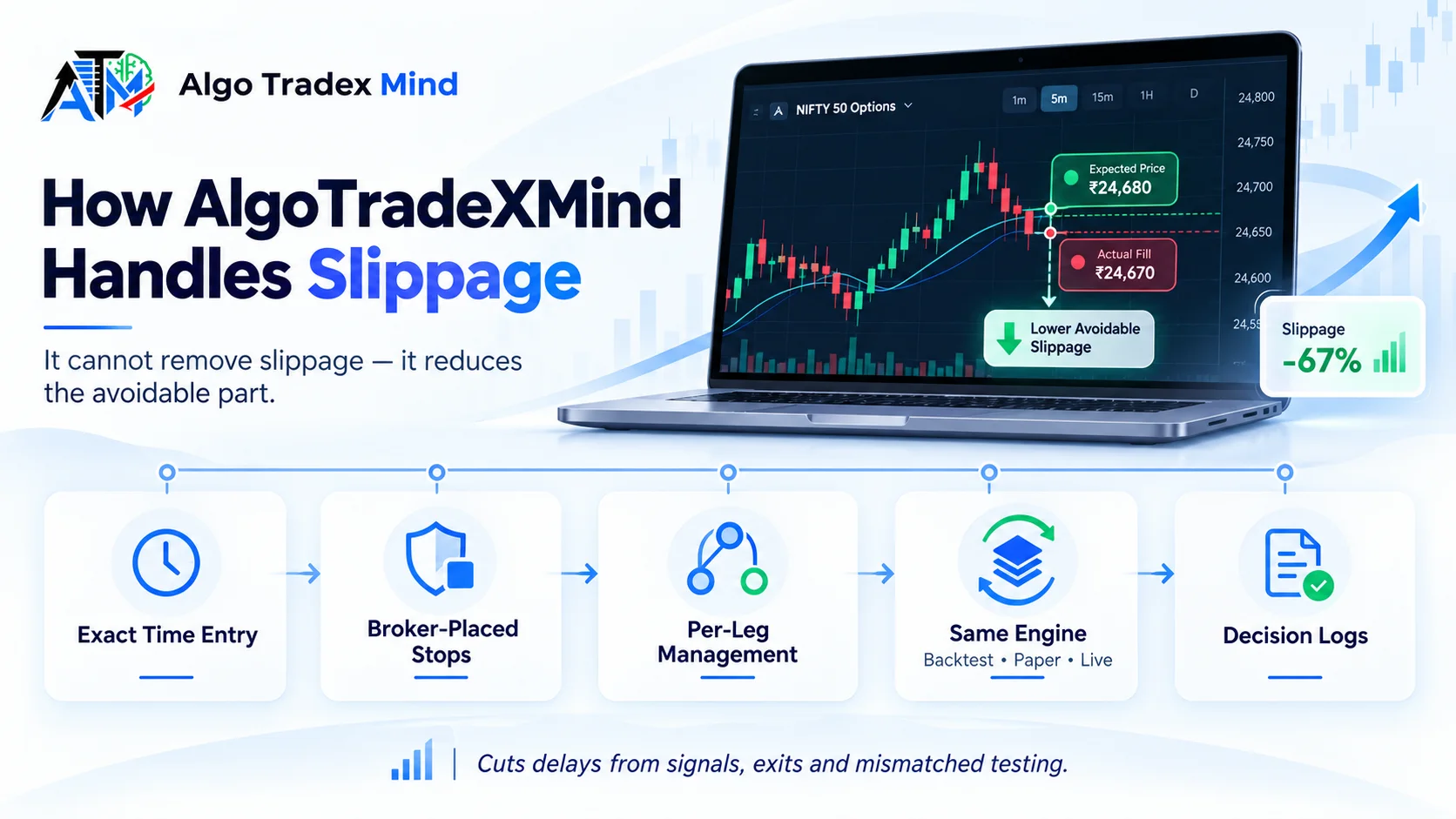
Algo TradeX Mind cannot remove slippage, because no platform controls the order book. What it does is cut the avoidable part, which comes from late signals, slow exits and backtests that do not match live behaviour. The platform runs NSE and BSE options strategies on your own broker account, and its execution design targets the timing gaps that usually widen fills. Here is how each feature connects to the problem.
Entries at the Exact Clock Time
A 09:20 strategy on AlgoTradeXMind enters on the first tick at or after 09:20:00, not at the close of a five-minute candle. Waiting for a candle close can put your entry several points or more away from the planned price, which is a form of slippage built into the logic itself.
Stop-Losses Placed With the Broker After Entry
Pre-punched stops place the stop-loss order with your broker immediately after entry. The order sits at the exchange and triggers there, so the exit does not wait for the platform to notice the price and send a fresh order. This matters most for slippage in options during sudden spikes, when every second of delay costs money.
Per-Leg Management on Multi-Leg Trades
Each leg in a straddle, strangle or iron condor carries its own stop, target and trail. When one leg hits its stop, the other leg is not closed in a rush unless you set that rule, which avoids unnecessary market exits that add to cost. The surviving leg also keeps its own stop in place.
One Engine for Backtest, Paper and Live
The backtester, paper account and live runner execute the same strategy code on 1-minute data, with charges included in backtest reports. Because the logic and costs match, the remaining gap between your backtest and live results points clearly to execution, so you can measure it instead of guessing at the cause.
A Record of Every Decision
Each run logs why an entry fired, why a stop moved and why an order was refused. You can set those timestamps beside your broker's fill prices and calculate your real slippage per strategy, per strike and per time of day. Paper trading with real lot sizes and margin rules gives you a testing stage before real capital is involved.
Together, these features help reduce slippage that comes from timing and process, while you control the market-driven part through strike choice and order type.
What Should You Check Before Taking an Options Algo Live?
Check whether your strategy still makes money after a realistic slippage cost is deducted. If a ₹1 per unit slip per execution turns the profit negative, the edge is too thin for live markets. Then run the strategy on paper for a few weeks, compare intended prices with actual fills and only commit real capital when the numbers hold up week after week.
- Backtest profit after deducting slippage and all charges
- Average spread of the strikes your strategy trades
- Your market vs limit order settings for entries, stop-losses and square-off
- Order quantity compared with the depth at the best price
- Strategy behaviour on expiry days and event days
- Daily loss cap and kill switch settings
Slippage is a cost you pay on every trade, whether you track it or not. Measure it, add it to your backtest and design your orders around it. A strategy that survives honest slippage figures on paper stands a far better chance when real money is on the line.
Frequently asked questions
Is slippage a charge taken by my broker?
No. Slippage is not a fee and does not appear on your contract note as a separate charge. It shows up inside the fill price itself. Brokerage, STT, exchange charges and GST are separate costs, and both types together decide your actual net profit.
How much slippage is normal for NIFTY options?
For at-the-money weekly NIFTY options during normal hours, ₹0.05 to ₹0.50 per unit is a typical range. It can jump to several rupees during sharp moves, news events or the last hour of expiry day. Your own fill records give the truest figure.
Does slippage happen in paper trading?
Paper trading usually shows less slippage than live trading, because simulated orders do not compete with real buyers and sellers. Treat paper results as a best case. Adding a fixed slippage cost per order gives you a more honest picture before you commit real capital.
Does expiry day increase slippage?
Yes, in many cases. Premiums on expiry day change quickly, especially after 13:00, as time value collapses and the index moves. Spreads on cheap out-of-the-money strikes can widen sharply. Many algo traders reduce position size or tighten order limits on expiry sessions.
Can slippage turn a profitable strategy into a losing one?
Yes. Strategies with small average profits per trade, such as frequent scalping or straddles with tight targets, are the most exposed. If the average slip per trade exceeds the average profit per trade, the strategy loses money even when the backtest looks strong.