

Algo trading can be profitable, but only for a small group of disciplined traders who test properly, control losses and account for every charge. So, is algo trading profitable? for an ordinary retail trader in India? SEBI data shows most individual derivatives traders still lose money. Automation removes hesitation and emotional exits, yet it cannot rescue a weak strategy. Profit depends on rules, costs and risk limits, not on code.
Is Algo Trading Profitable for Retail Traders in India?
For most retail traders, it is not, at least not yet. SEBI's FY25-FY26 study found that 87.7% of individual equity derivatives traders lost money in FY26, after costs. Yet about 99% of the gross profits earned by proprietary firms and foreign investors came from entities using algorithms. Automation clearly works for some. The difference lies in testing, cost control and strict loss limits, not in the software itself.
What do the latest SEBI numbers show?
- 87.7% of individual F&O traders made a net loss in FY26, down from 90.9% in FY25.
- Before charges, 82.1% were in loss, so costs alone pushed thousands of break-even traders into the red.
- Only 0.5% of traders active from FY22 to FY26 made a profit in all five years.
- The median gain in a winning quarter was ₹4,366, while the median loss in a losing quarter was ₹10,525.
Does automation change those odds on its own?
No. A bot follows instructions exactly, which is both its strength and its weakness. It will enter at 09:20:00 every morning without fear, and it will also repeat a bad rule every morning without question. Institutions profit because they pair automation with research, low costs and tight limits. A retail trader who copies the automation but skips the rest usually reaches the same outcome, only faster.
What Returns Can You Realistically Expect from Algo Trading?
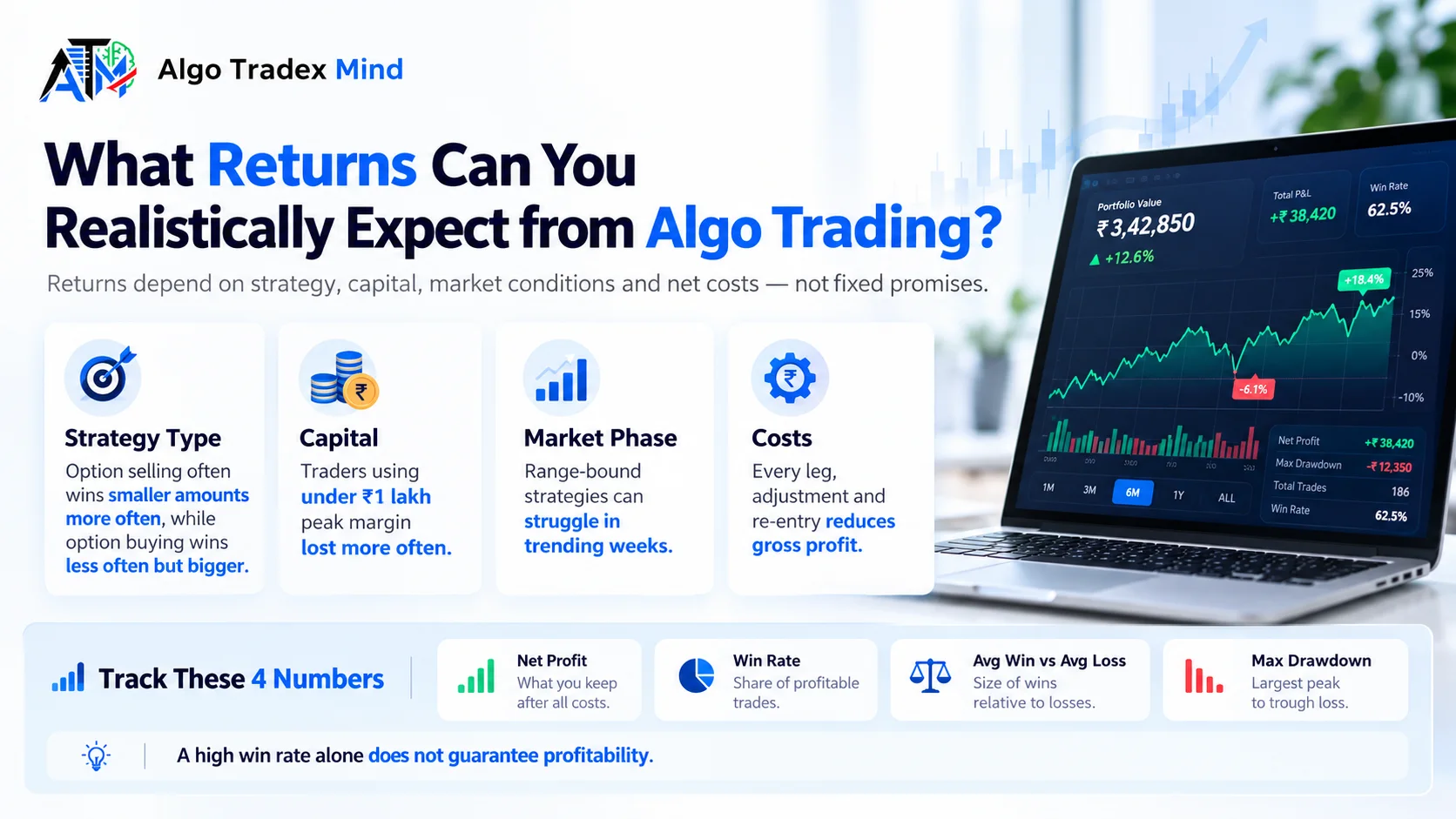
No honest figure exists, and anyone promising a fixed monthly percentage deserves suspicion. Algo trading returns depend on the strategy type, capital, market volatility and, above all, net costs. A well-tested intraday options strategy might deliver steady gains for months and then give back a large share in one bad week. Judge returns over at least a year, after charges, against the worst fall along the way.
What shapes the returns you actually keep?
- Strategy type: option selling tends to win often in small amounts, while option buying wins less often but bigger.
- Capital: SEBI found that 90% of traders using under ₹1 lakh of peak margin lost money. Larger accounts lost less often, though their losses were heavier when they came.
- Market phase: a strategy built for range-bound sessions can struggle badly in a trending week.
- Costs: every leg, adjustment and re-entry chips away at gross profit.
Track four numbers instead of one: net profit, win rate, average win against average loss, and the deepest fall from a peak. A strategy that wins 75% of the time can still bleed money if its losing trades are three times larger than its winners.
Why Do Most Algo Traders Lose Money?
Most losses come from untested rules, oversized positions and costs that traders never counted. The reasons why algo traders lose money are rarely technical. People backtest on a few months of data, fit rules to past noise, then trade too large a quantity. When the first rough patch arrives, they switch the strategy off at the bottom and restart something new, locking in the loss.
The backtest that looked too good
Overfitting is the most common trap. A trader adds filter after filter until the equity curve looks smooth, but those filters only describe the past. Backtests also mislead when they fill orders at the candle close instead of the actual entry time, or when they ignore charges entirely. Watch for these warning signs:
- The strategy works on one index and one year only.
- Small changes to the entry time or stop-loss wreck the results.
- Fewer than 100 trades sit behind the numbers.
- The report shows gross profit without taxes, fees or slippage.
The emotional part that code cannot remove
Automation removes the urge to exit early, but it cannot control the person who owns the account. Watching three months of gains vanish in one expiry week genuinely hurts. Many traders respond by overriding stops, doubling quantity to win it back, or abandoning a sound strategy during a normal dip. SEBI also found that traders active on more than 100 days a year made up 42% of traders but carried 87% of the losses. Trading more did not mean earning more. That pattern explains a large part of why algo traders lose money even after they automate: the rules keep changing whenever emotions run high.
What Are the Biggest Risks in Algo Trading?
The biggest algo trading risks are sudden market moves, technical failures and rules that stop matching market conditions. Option-selling strategies carry tail risk, where one sharp move erases months of small gains. Technical risks include broker API outages, expired login sessions and duplicate orders after a server restart. Regulatory changes can also break a working setup overnight, as SEBI's 2026 retail algo framework showed.
Market risk and the option seller's problem
SEBI's FY26 data puts hard numbers on this. About 90% of pure option buyers lost money. Only around 44% of traders who mainly sold options ended in loss, which sounds reassuring until you see the size. Their average loss was roughly ₹51.7 lakh, against about ₹1.3 lakh for option buyers. A high win rate does not mean low risk.
Technical and operational risk
- Broker sessions expire daily and must renew before the market opens.
- A server restart mid-session can leave positions open without their stops.
- Network delays turn a planned price into a worse fill.
- A wrong strike or quantity entered once repeats on every single trade.
Platform design matters here. AlgoTradeXMind, for example, recovers open positions after a restart, squares off orphaned ones and refuses duplicate orders by design, which closes some of the most common technical gaps.
Regulatory risk
SEBI's framework for retail algo trading became mandatory for all brokers from 1 April 2026. Orders sent through broker APIs now need a whitelisted static IP and a fresh two-factor login each trading day. Strategies that send orders above a set per-second limit must be registered with the exchange. Each of these algo trading risks has a practical fix, and most of the fixes sit in the limits you set before going live.
What Is Drawdown in Algo Trading and How Much Is Too Much?
A drawdown is the fall in your account from its highest point to its lowest point before it recovers. It shows how much pain a strategy puts you through, not just how much it earns. Many experienced traders treat a worst historical fall above 20% to 25% of capital as a warning sign, because recovery becomes much harder as losses deepen.
How hard is it to recover from a loss?
- A 10% loss needs an 11% gain to get back to the starting point.
- A 20% loss needs a 25% gain.
- A 33% loss needs a 50% gain.
- A 50% loss needs a 100% gain, which few strategies ever deliver.
Expect live losses to run deeper than the backtest. A sensible approach is to plan for a worst fall of about 1.5 to 2 times the largest one seen in testing, then size positions so that figure stays bearable for your capital and your nerves.
How Much Do Brokerage, Slippage and Taxes Cost an Algo Trader?
Costs often decide whether a strategy makes or loses money. SEBI found individual F&O traders paid around ₹25,000 crore in transaction costs in FY26, with brokerage making up about 44% and STT about 27%. Charges alone moved the share of loss-making traders from 82.1% to 87.7%. For frequent strategies, the combined brokerage and slippage cost can swallow half the gross profit.
Which charges apply on every F&O trade?
- Brokerage: usually a flat fee per executed order at discount brokers.
- Securities Transaction Tax: from 1 April 2026, 0.15% on the options premium and 0.05% on futures, both on the sell side, up from 0.1% and 0.02%.
- Exchange transaction charges, SEBI turnover fees and stamp duty.
- GST at 18% on brokerage and exchange charges.
- Slippage: the gap between the price you expected and the price you actually got.
A simple cost example
Picture an intraday options strategy that books ₹800 in gross profit on an average day. Brokerage and statutory charges take about ₹220, and slippage across four legs adds another ₹200. The trader keeps ₹380, which is less than half. Across 240 trading days, costs come to more than ₹1 lakh. These are illustrative figures, but the lesson holds: the brokerage and slippage cost must sit inside every backtest, not outside it.
How can you keep trading costs under control?
- Trade fewer, clearly defined setups instead of making frequent adjustments.
- Avoid deep out-of-the-money strikes with wide bid-ask spreads.
- Use limit orders or price protection on thinly traded contracts.
- Recalculate your breakeven after every tax or fee change.
How Does Risk Management Keep an Algo Trading Account Alive?
Good risk management limits how much you can lose on a single trade, a single day and a single bad week. It works through fixed position sizes, stop-losses on every leg, a daily loss cap and a kill switch. These limits matter more than entry signals, because a strategy with average entries and strict exits usually outlasts a brilliant one with no exits.
Which rules should you set before going live?
- Risk no more than 1% to 2% of capital on any single trade.
- Set a daily loss cap and let the system stop trading once it is hit.
- Limit trades per day to block revenge trading after a loss.
- Keep margin usage well below what the broker allows.
- Fix a square-off time so no intraday position drifts into the close by accident.
Why does enforcement matter as much as the rules?
Rules only help if the system enforces them before an order leaves. On AlgoTradeXMind, every order passes margin, daily loss, maximum trade, market-hours and kill-switch checks before it reaches the broker, and the same checks run on the paper account. Each leg carries its own stop, target and trailing stop, so a stop on one leg does not close the other unless the trader chooses that. The platform also records why each entry fired and why any order was refused. That kind of enforced risk management removes the temptation to bend rules in the middle of a tense session.
How Can You Test an Algo Strategy Before Risking Real Money?
Test it in three stages: a backtest on minute-level data with all charges included, a paper-trading run of one to three months, and then a small live deployment. Each stage should broadly confirm the previous one. If paper results drift far from the backtest, the backtest was probably unrealistic. Only increase quantity once live results match what your testing predicted.
What should you check in a backtest report?
- Net profit after every charge, not gross profit.
- The worst drawdown and how many weeks recovery took.
- Average win compared with average loss.
- Trade count and test period, ideally two years or more across calm and volatile phases.
- Results on data the rules were never built on.
Anyone asking is algo trading profitable for their own setup will find the real answer in these numbers, not in a headline return figure.
Why should testing and live trading use the same engine?
Many backtests flatter a strategy because the test engine and the live engine behave differently. AlgoTradeXMind runs its backtester, paper account and live runner on the same strategy code. Time-based entries fill at the bar where the clock time falls, and indicator rules evaluate only on closed candles. Its free paper account uses a simulated ₹10 lakh balance with real lot sizes and margin calculations, so traders see realistic behaviour before any capital is at stake.
What Is the Smartest Way to Start Algo Trading?
Begin with one simple, rule-based strategy, test it on minute-level data with charges switched on, and run it on paper until the results feel predictable. Then go live with the smallest quantity possible and fixed loss limits. Scale up only after a few months of live results match your testing. Patience at this stage costs nothing, while impatience often costs an entire account.
A practical starting checklist
- Pick one index and one strategy you can explain in two sentences.
- Backtest across at least two years with every charge included.
- Paper trade for one to three months and compare the results with the backtest.
- Go live with one lot, a daily loss cap and a working kill switch.
- Review the trade log every week and change only one variable at a time.
Treat algo trading returns as the reward for surviving the bad weeks, not as a monthly salary. The traders who last are rarely the ones with the cleverest code. They know their numbers, respect their limits and stick with tested rules long enough for the edge to show.
Frequently asked questions
How much money do I need to start algo trading in India?
There is no legal minimum. Option-buying strategies need enough capital for at least one lot, while option-selling strategies need far more margin. SEBI data shows traders using under ₹1 lakh of margin lost most often. Practising on a paper account first costs nothing.
Can I do algo trading without coding knowledge?
Yes. No-code platforms let traders build rules through forms and condition pickers instead of writing scripts. You choose the instrument, legs, entry time, stop-loss and exit time, then backtest the result. Understanding the strategy logic still matters far more than knowing a programming language.
Is algo trading legal for retail traders in India?
Yes. SEBI permits retail algo trading through registered brokers, and its updated framework has applied to all brokers since 1 April 2026. API orders need a static IP and daily login authentication, and faster strategies above a set order limit need exchange registration.
Is selling options with an algo safer than buying options?
Not necessarily. SEBI found option sellers lost less often than buyers, but their average loss was far larger. Selling tends to win small amounts frequently and occasionally lose heavily. Without hard stops and position limits, one sharp move can erase several months of gains.
Do good backtest results guarantee future profits?
No. A backtest only shows how a set of rules would have behaved on past data. Markets change, costs rise and live fills differ from simulated ones. Treat a strong backtest as permission to start paper trading, not as proof that real money will grow.
What Is the Smartest Way to Start Algo Trading?
Begin with one simple, rule-based strategy, test it on minute-level data with charges switched on, and run it on paper until the results feel predictable. Then go live with the smallest quantity possible and fixed loss limits. Scale up only after a few months of live results match your testing. Patience at this stage costs nothing, while impatience often costs an entire account.
A practical starting checklist
- Pick one index and one strategy you can explain in two sentences.
- Backtest across at least two years with every charge included.
- Paper trade for one to three months and compare the results with the backtest.
- Go live with one lot, a daily loss cap and a working kill switch.
- Review the trade log every week and change only one variable at a time.
Treat algo trading returns as the reward for surviving the bad weeks, not as a monthly salary. The traders who last are rarely the ones with the cleverest code. They know their numbers, respect their limits and stick with tested rules long enough for the edge to show.